 DirectToGrowth Co.

When a product underperforms on retail shelves, the story writes itself: "customers just aren't buying it." It is a comfortable conclusion because it lets everyone off the hook. In my experience it is also, more often than not, wrong. The demand is usually there and the execution is not, and you can test which with a file you almost certainly already have: the raw sales export from the retailer.
"Our product isn't selling" is a demand claim. "Your stores aren't executing" is an execution claim. The export tells you which one you can defend.
The 7-step execution audit
The goal is to separate a demand problem (people do not want it) from an execution problem (people cannot find, reach or buy it). The short version: tier the stores by velocity, compare units per store per week across the tiers, check availability, model the low tier reaching the middle, and corroborate with online demand. The sequence I run:
Normalize the export. Clean the raw retailer file into consistent units, stores and weeks so you can compare like with like.
Segment stores into velocity tiers. Group locations into low, mid and high sellers. Velocity is a proxy for execution quality on the ground, not a measurement of it.
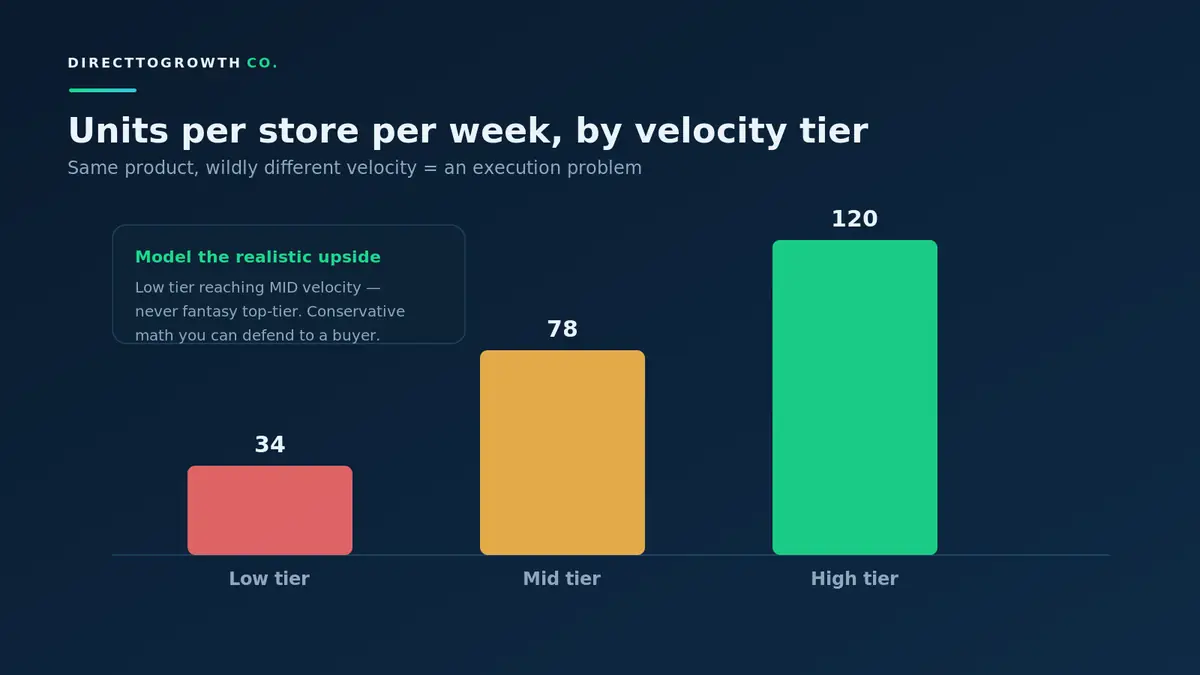
Compare units per store per week across tiers. If the top tier moves several times the volume of the bottom tier for the same product, demand exists somewhere, and the question becomes what is different about the low tier.
Look at distribution and availability, not just sales. A store selling zero may be a store that never had stock on the shelf, not a store with no interested shoppers.
Model realistic upside. Estimate the gain if low-tier stores merely reached mid-tier velocity, not the gain if every store performed like your best one.
Read online demand as corroborating evidence. If the same SKU over-indexes online in a region where it stalls in stores, that points at in-store availability or placement, not lack of interest.
Translate findings into store-level actions. Point to the specific tier, the specific gap and the specific fix.
Why velocity tiers carry the argument
The most persuasive view I have found is units per store per week, split by tier. Demand-level factors, how appealing the product is, whether people want the category, tend to vary less from store to store than execution does. So when identical products sell fast in one tier and stall in another, demand alone does not explain it. Shelf placement, stock, staff, signage or the retailer's own operations usually do.
I stop short of calling the spread proof. Store format, local competition and the retailer's merchandising calendar all live inside it, and a tier split cannot separate them on its own. It tells you where to look and gives you a number to put on the table, which is more than "it isn't selling" ever will.
The honesty that protects your credibility
The fastest way to lose a buyer's trust is to model the low-tier stores suddenly performing like your best doors. Nobody believes it, and you should not either. Model the low tier reaching the middle. That is a grounded, defensible number, and it is usually more than enough to justify the fix. Conservative math you can stand behind beats aggressive math that gets you laughed out of the meeting.
Get the data before the meeting, not in it
The whole analysis depends on one unglamorous prerequisite: you need the raw sell-through data before you walk into the room. Request supplier-portal and retail-media access early, and find out who actually controls your reporting. If your only window into your own performance is a commissioned rep agency or a middleman, you are negotiating blind and they know it. Own the export, and you own the conversation.
Two conditions on the method itself. It needs store-level, weekly data; if the retailer only gives you aggregate sell-through, the first job is getting the granular export, not the analysis. And with a few dozen doors the tiers get thin and one store can swing a tier, so I would still look, but hold the conclusions more loosely.
How the conversation changes
Walk into a retail review with this analysis and the discussion shifts. You are no longer defending your product against a vague charge that it does not sell. You are pointing at a specific set of underperforming stores and a specific execution gap, with the retailer's own data on the table. Same file. Different meeting.
The same discipline applies to your own team's story. "We tried retail and it failed" is one of the most expensive sentences in consumer goods, because it closes a door the data might have kept open. One brand I worked with had ruled out Canada on Amazon after an early trial produced bad reviews. In the data, the reviews tracked the product version, not the market: the 1.0 SKU with known issues was the one selling in Canada, and it drew the same complaints in the US. A SKU distribution problem, not a marketplace problem, and the question changed from whether Canada was viable to which products should go in.
What I would tell a CEO: run the audit before you accept the demand story, and define the failure with numbers before anyone's memory gets a vote. If the velocity spread is flat across tiers, availability is fine everywhere and online demand is soft in the same regions, I would take the demand explanation seriously. That is the evidence that changes my mind, and in my experience the file rarely contains it.
FAQ
How do I tell whether a product is failing in retail because of demand or execution?
Tier the stores by velocity and compare units per store per week for the same product. A wide spread says demand exists somewhere and the question is what differs in the low stores: stock, placement, staff. A flat spread, with availability fine everywhere and online demand soft in the same regions, is when I take the demand story seriously.
What data do I need from the retailer to run this audit?
The raw sell-through export at store and week level, before the meeting rather than in it. Request supplier-portal and retail-media access early and find out who controls your reporting; if a rep agency is your only window, you are negotiating blind.
How should I model the upside when I pitch the fix to a buyer?
The low-tier stores reaching mid-tier velocity, not every store performing like your best doors. It is a number the buyer can believe, usually enough to justify the fix, and it keeps your credibility for the next conversation.