 DirectToGrowth Co.
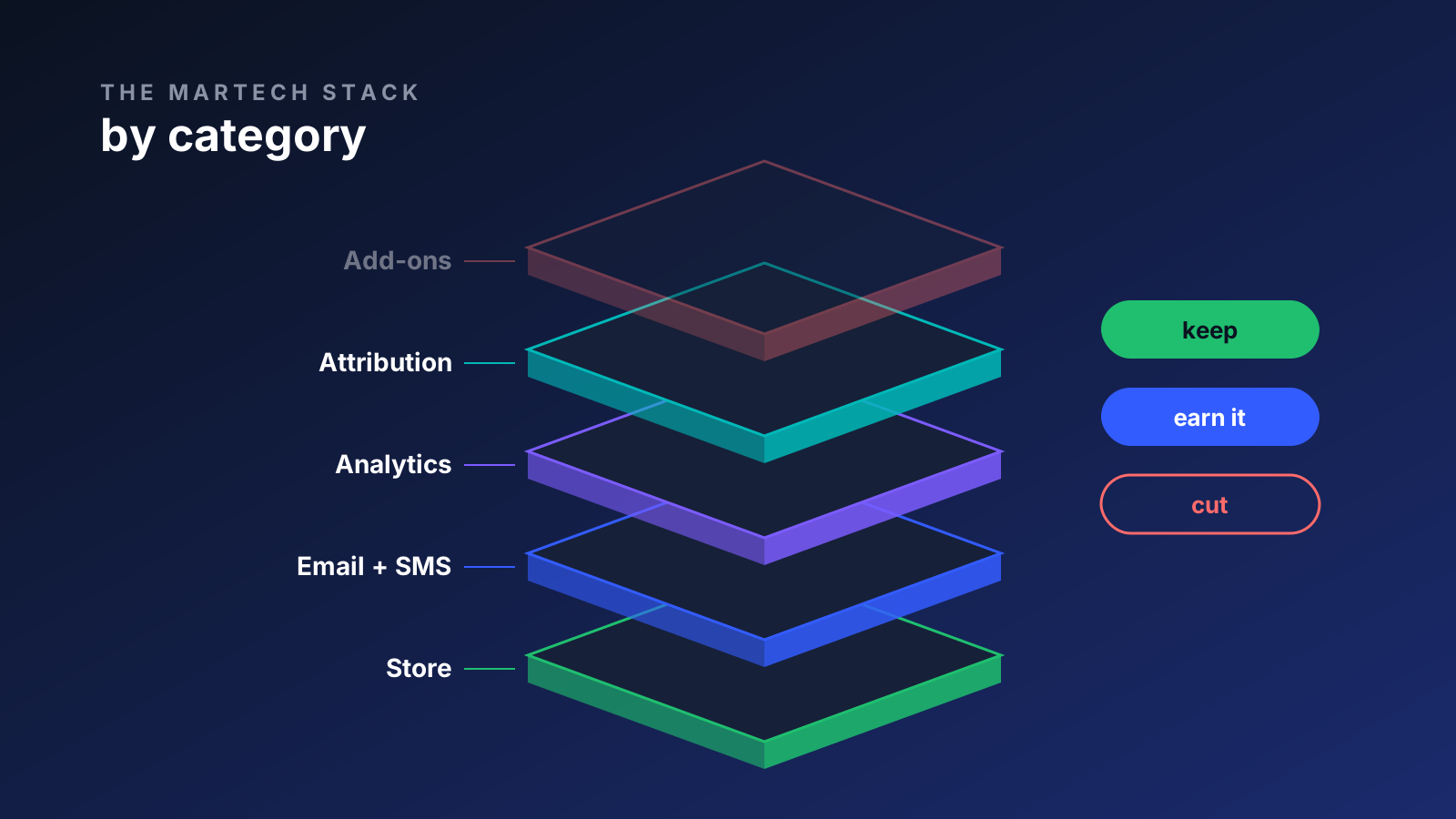
Every new client hands me two things in week one: a P&L and a list of software subscriptions. The second is usually longer than anyone expects. Thirty-plus tools is a normal D2C martech stack. Some of them overlap. A few are still billing for someone who left the company last year.
Nobody built that stack on purpose. It grew one demo at a time. Every tool was bought to solve a problem, and almost none was ever asked to keep proving it.
A tool earns its seat by changing a decision. If nothing would change without it, it's a subscription, not a system.
The three-bucket test
I sort every category into one of three buckets. It takes about an hour with the subscription list and a finance export, usually in the same first month I check how marketing spend is tagged in the P&L.
Must-have: the stack you can't run without
Store platform. For most D2C brands that is Shopify. The pro is the app ecosystem. The con is also the app ecosystem: every app adds script weight and another bill.
Email and SMS. Klaviyo is the default for a reason: the Shopify data sync is deep and flows are easy to build. The catch is that pricing scales with profile count, so list hygiene is a cost line, not a nice-to-have. SMS (Postscript, Attentive or Klaviyo's own) earns its place once email is working, not before.
Reviews. Okendo, Yotpo, Judge.me. They all collect reviews fine. Pick the one that syndicates to the places you sell and stop comparing.
Helpdesk. Gorgias or similar. Underrated as a marketing tool: support tickets are the best voice-of-customer research you will ever get for free.
Analytics you trust. Note the wording. Not "analytics." GA4 plus the Shopify reports is enough for a lot of brands, as long as someone has checked that the numbers tie out and it can produce the two figures finance will ask for: blended new-customer CAC and marketing spend as a share of net revenue.
Earn its seat: useful, if someone uses it
This is the expensive middle. Every one of these can be great, and every one can be shelfware.
| Category | Earns it when… | Shelfware when… |
|---|---|---|
| Attribution tool | Someone reallocates budget from it every week. | It's a second dashboard the team screenshots for the Monday deck. |
| Testing / CRO | You have the traffic to reach a result in weeks, not quarters. | Tests run for months and get called on a hunch. |
| Creator + affiliate | Creators are a real channel with a budget and an owner. | Twelve gifted creators and a dashboard nobody opens. |
| Subscriptions | The product is genuinely replenishable. | You bolted it on because a competitor has it. |
| Warehouse + BI | Questions span three or more tools every week. | One person built it, then left. |
One rule for the attribution tool: the model stays the same for every comparison, or it is a second dashboard, not a decision. Personalized landing pages sit here too. They earn their seat when you send real volume from creators or ads to a single page, not when you have three campaigns a year.
Usually skip: the tools that sell well in demos
A CDP before you need one. Segment and RudderStack are excellent. Under roughly $20M in revenue, most brands are paying to move data between three tools that already integrate natively.
A second tool for the same job. Two email platforms. Two review apps. Two attribution dashboards that disagree. Pick one, migrate, cancel.
AI "insight" add-ons. If it summarizes a dashboard you already have, it is a summary, not an insight. I use AI heavily, on raw data with rules, not as another subscription layered on top.
Pop-up stacks. One capture tool. Not three that fight each other on mobile.
How to run the audit this week
- Export every software charge from the last 90 days. Card statements catch what the finance tool misses.
- For each tool, write one sentence: "We changed ___ because of this tool last month."
- Blank sentence? It goes in the cancel or consolidate column.
- Check seat counts and plan tiers. Downgrades are often worth more than cancellations.
- Set a calendar reminder 30 days before each annual renewal. That is when you can negotiate.
What I would tell a CEO: the best stack is not the biggest one. It is the one where every tool has an owner, a job, and a decision it changed recently.