 DirectToGrowth Co.
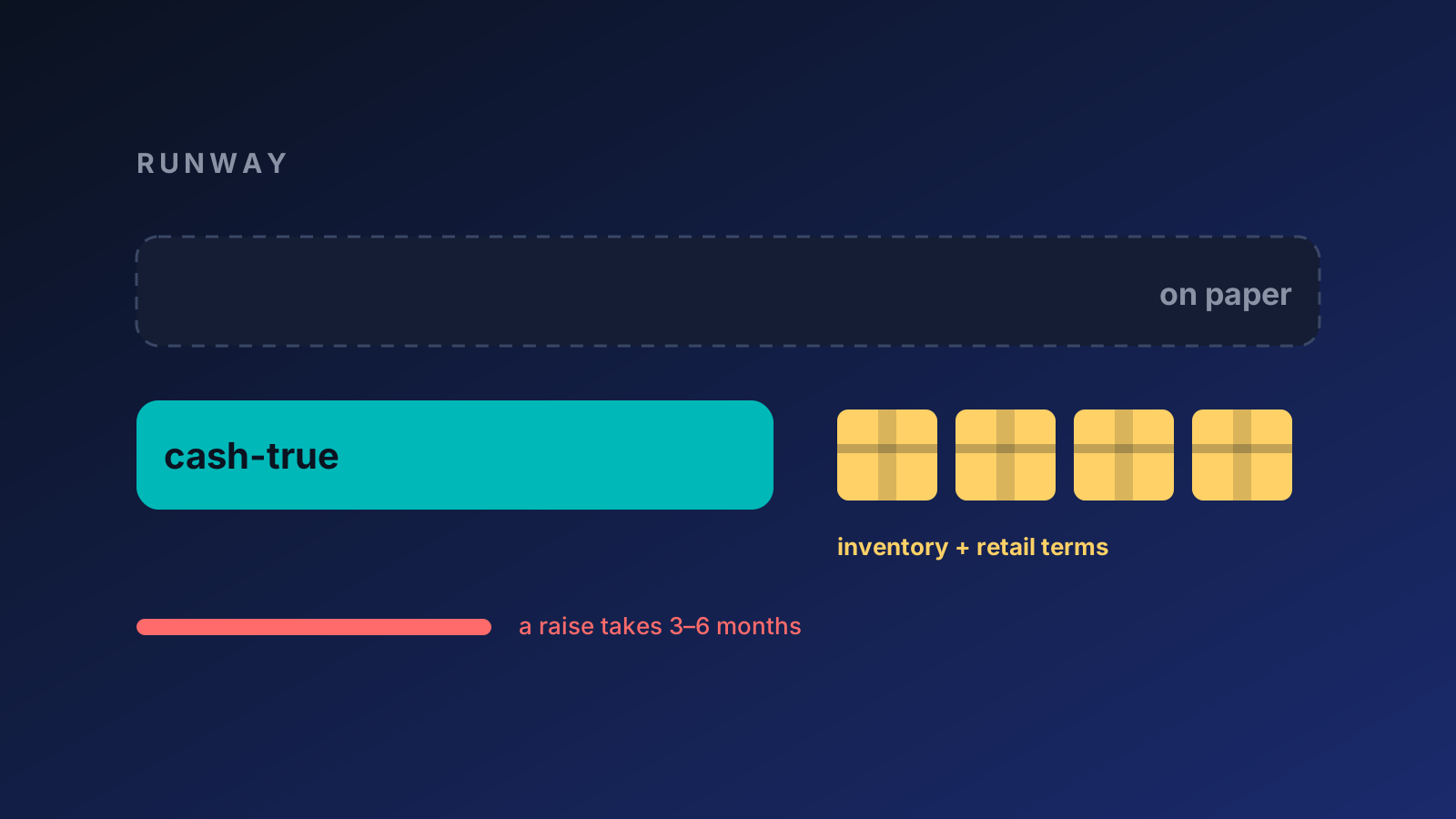
Every runway guide I have read is written for software. Cash in the bank, divided by monthly burn, equals months left. Clean. For a brand that sells physical product it is wrong in a way that only shows up when it is too late to fix.
The short answer to how much runway you need before you raise: start with nine to twelve months. For a consumer brand, measure those months in cash-true terms, after inventory, retail terms and your peak season, not cash divided by average burn.
Software burns cash. Consumer brands burn cash and park it in a warehouse.
Why the textbook runway number lies for D2C
Three things eat runway that a net-burn calculation never sees.
Inventory purchase orders. You pay for Q4 product in the summer. A big PO can take months of "runway" off the table in a single wire, committed long before the revenue shows up.
Retail terms. A new retail partner is good news for the deck and bad news for cash. You ship, then wait 30, 60, sometimes 90 days to get paid. The faster retail grows, the more cash it locks up.
Seasonality. An average monthly burn hides the months that matter. If burn spikes in September and October and collections land in December, the average says you are fine right up until you are not.
The same brand, two runway numbers
An illustrative example. $1.2M in the bank. Average net burn of $80K a month. On paper, fifteen months. Plenty of time.
Now add what is already committed. A $400K inventory PO for holiday, due in July. $150K tied up in receivables from a retail launch on 60-day terms. Take those out and there is $650K left to fund the burn. At the same $80K a month that is about eight months, and less if burn peaks in Q4.
That is the difference between starting a raise calmly and starting one with your back against the wall.
How to calculate cash-true runway
- Start with cash in the bank today.
- Subtract inventory POs you have committed to but not paid.
- Subtract cash you are waiting on from retail and wholesale partners that you cannot count on collecting on time.
- Forecast net burn month by month, including the peak-season inventory build and marketing, instead of using an average.
- Count the months until cash crosses a floor you would never let it go below. That is your runway.
If you already have a proper operating model with an inventory and working-capital tab, this is a ten-minute exercise. If you do not, that is the first problem to solve, before the deck.
This is also where the marketing plan and the cash plan have to meet. In the first month with a brand I sit with finance and work out what the business can stomach: a six-month payback on new customers is a very different cash plan from a twelve-month one, and the inventory build has to fit around whichever you pick.
How long a raise actually takes
| Phase | Typical length | What slows it down |
|---|---|---|
| Prep — model, deck, data room | 3–6 weeks | Building the model after the deck instead of before it. |
| First meetings | 3–6 weeks | Sending the long deck cold. Vague ask. |
| Finding a lead | 2–8+ weeks | No proving metric. A spike instead of a trend. |
| Diligence | 2–4 weeks | Numbers that don't reconcile. A half-built data room. |
| Legal + close | 3–6 weeks | Changing the instrument mid-process. |
Add it up and three to six months is normal, longer if you are still looking for a lead. Prep should not count against your clock. Do it before the first meeting is booked.
When to start: the signals I look for
- Nine to twelve months of cash-true runway. Under six and the terms start to show it.
- A closed month you are proud of. Raise on actuals, not a forecast.
- Three or more quarters of the proving metric moving the right way. A trend is a story; one great month is a question.
- Your strongest season in the latest numbers. Time it so diligence covers the peak, not the trough after it.
- The structure decided. Equity, a note, or a mix, before the first call.
Running low: the options before a rushed round
If the cash-true number came back smaller than you expected, you have more levers than a desperate raise.
Inventory financing or PO financing can carry the seasonal build without spending equity on it. Revenue-based financing can bridge a predictable gap. Renegotiating supplier terms, even 30 extra days, can be worth months of runway. And cutting the spend that does not pay back buys time without anyone's permission. I look at ad spend as a share of net revenue first, because that is where most brands are quietly overspending, and it is the one line finance and marketing can agree on without an attribution argument.
None of these replace a raise. They let you run one from the right side of the table.
What I would tell a CEO: runway is not a number in the bank. It is the time you have to say no to a bad term sheet. Count the inventory, agree the floor with finance, and start before you need to.
FAQ
How much runway should you have before you start fundraising?
Nine to twelve months of cash-true runway. A round usually takes three to six months from first meeting to money in the bank, and starting with less than six months shows up in the terms.
How do you calculate runway for a D2C brand?
Start with cash, subtract committed inventory purchase orders and the cash tied up in receivables and retail terms, then forecast net burn month by month rather than using an average. A seasonal brand should model the peak-season inventory build explicitly.
How long does a fundraising round take?
Plan for three to six months from first meeting to cash in the bank, longer if you still need to find a lead investor. Preparation, meaning the model, deck and data room, should be done before the clock starts.
How much runway should a round buy?
Enough to hit the milestones that make the next round easy, plus a buffer. For most consumer brands that is eighteen to twenty-four months at the planned burn.