 DirectToGrowth Co.
I spent the last few months building a pitch deck for a consumer brand I work with. Six versions. One advisor read. Two rounds of investor questions. Most of what I believed about pitch decks going in did not survive the process. This is what did.
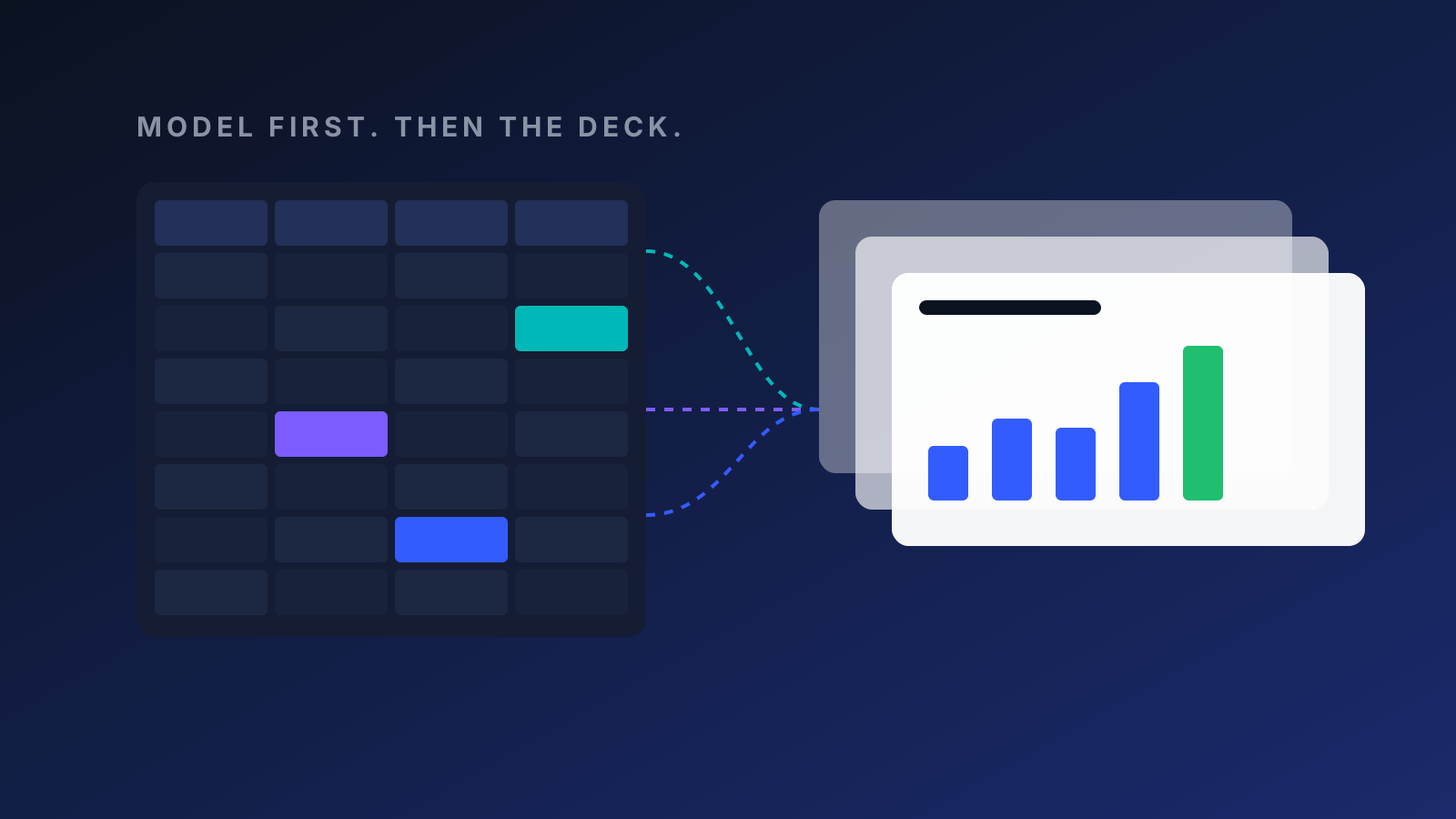
The deck is a view of the model
We sent the first version before the model was finished. Problem, product, traction, team, ask. It read well. Then the investor questions came back, and every one of them was a model question. Where does this margin come from. What does retention look like by cohort. How does the forecast split by channel.
So we stopped and built the thing we should have built first. Monthly P&L by channel. Cohort retention. Unit economics per order. A 24-month forecast with every assumption on its own row. (Here's how I lay that model out, tab by tab.) Then we rebuilt the deck as a set of views into that model. Every chart pulls from a tab. Every claim has a cell behind it.
Get that order right and most deck problems disappear. A deck is a summary. If there is nothing underneath it to summarize, investors find out in the second meeting.
Every number has to agree with every other number
Investors do not read a deck front to back. They read slide 10, then flip to slide 26 to check it. Decks fail in the gap between the two.
Before any version leaves, we run a reconciliation pass. Revenue on the traction slide equals revenue in the P&L appendix. Gross and net are defined once and used the same way everywhere. The customer count on the cohort chart matches the count on the scorecard. Where a chart uses a different period or a different basis, it says so in a footnote, under the chart, in small type.
The numbers that look bad get the same treatment, only earlier. If margin compressed because you chose to fund retail launches or subscription acquisition, say so under the chart in one line, before anyone asks.
An unexplained dip reads as a problem. An explained one reads as a decision.
Name your scenarios like an operator
We had a slide called Bear and Bull. The advisor read it once and told us to rename it. They were right.
Bear and bull are trader words. They tell an investor you are guessing at a range and hoping for the top of it. Base and upside are operator words. The base case is the plan you expect to be held to. The upside is what the money makes possible if the growth engines work. Same numbers, different signal.
Build the upside bottom-up, engine by engine (retail doors, subscription attach, a new market), with the assumption behind each one printed on the slide. A top-down "if we capture 2% of the market" upside is a reason to stop reading.
The pitch deck structure: seventeen slides in four acts
The short deck we landed on is seventeen slides, and the order took longer to get right than any single slide did. Investors decide in the first three whether to keep reading, so the deck has to earn attention before it spends it.
1. The hook: slides 1 to 4
Cover. Then one full-bleed image that says what the brand is without a paragraph. Then the numbers slide: three or four figures that carry the whole pitch (growth rate, scale, the share of revenue that recurs) and nothing else on the page. Then the problem, drawn as a picture rather than written as bullets. By slide 4 the reader knows what you sell, how fast it is growing and why the category exists. Most decks are still on the mission statement.
2. The product and the moat: slides 5 to 9
What you actually sell, at what prices. How you priced your way from a prestige launch to the mass market, and which product carries the margin and the subscription. Why the category is mostly white-label and why you are not. Third-party proof that the product outperforms the brands people have heard of. And a logo wall of who already stocks you, because distribution is proof too. Every claim slide is followed by a proof slide. That alternation is most of the trick.
3. The numbers: slides 10 to 14
Revenue and profit history on one chart, so "growing and profitable" is a picture, not a sentence. Where the revenue comes from, by channel. Then the proving chart. For a subscription brand that is cumulative revenue per customer and retention by cohort; for a retail brand it is velocity per door; for a marketplace it is repeat rate. It is the slide you are actually raising on, and it sits in the middle, after the history has made it credible and before the forecast depends on it. Then the path to scale, base case against upside. Then the upside broken into its engines, one bar each, so the big number on the previous slide has visible parts.
4. Belief: slides 15 to 17
Cultural proof: who uses it, and who vouches for it. The team, late, because for a business with traction the numbers are the credential and the team slide confirms rather than convinces. Then the ask, as the last thing on the screen.
Two tests before you call the order done. Read only the seventeen titles, top to bottom. If they form an argument on their own, the flow works. Every title should be a conclusion, with the basis in the subtitle and the source in the footnote. Then find the dense stretches and put a breath between them. One image slide after four slides of charts resets attention for the next four.
The ask is a slide, not a conversation
Founders leave the ask vague so they can see where the conversation goes. Investors read a vague ask as a founder who has not done the math on their own runway.
The ask slide has five things on it. The amount. The minimum close you can operate on. The instrument, equity, a note, or both, decided before the first meeting rather than negotiated in it. The use of funds, split by growth engine rather than by department, so each dollar maps to a line in the upside case (more on that slide here). And the milestones the money buys in the next twelve months, stated plainly enough that an investor can check them later.
Valuation is not on the slide. It is a discussion item, and it should move with the conviction in the room.
Send the short deck. Keep the long one for the data room.
We ended up with two decks built from one source file. The seventeen-slide version for the cold email and the first meeting. And the full version, twice as long, with an appendix of P&L detail, cohort tables, retail sell-through and the model assumptions, for the data room once someone is serious.
The appendix is the diligence questionnaire answered in advance, in the order investors ask: growth by channel, retail build by partner, international, product lines, the profit path, base against upside in one table, acquisition cost and new customers by quarter, the scorecard, the LTV levers, per-customer economics, then the customer proof. (The full data room checklist is here.)
Sending the full deck cold is a mistake. Nobody reads the appendix before a first call, and it invites questions you would rather answer in person with the model open. Lead with the short deck. Earn the long one.
The last 10% is design, and investors notice
Design does not get you funded. Bad design gets you discounted. Polish is a cheap proxy for how you run everything else, and investors use it.
The list that mattered for us: one font family everywhere, charts included. Titles in the same position on every slide. Native charts instead of pasted screenshots, so the numbers survive a projector. High-resolution images, because a blurry product shot on a premium brand's deck is an argument against the brand. And nothing empty. A headshot circle with no photo in it was the first thing the advisor flagged, before anything about the numbers.
Then open the file in the software investors actually use. A deck built in Google Slides renders differently in PowerPoint and in Keynote. Check all three before you send it.
How we actually built it
The production work was done by AI. Thirty-five slides restyled to one type system overnight. Every chart rebuilt at full resolution. Font sizes raised across the whole deck in one pass, then pulled back on the handful of slides where it crowded. Two decks exported from one source, so the short one never drifts from the long one.
What the AI did not do was decide what a number should be. Every figure on every slide was checked by a person against the model, with the same gates I use for the weekly business review. Machines own layout, consistency and resolution. People own the numbers and the story. Most teams have that split backwards.
When to raise
Everything above is about the deck. The harder question is timing, and most of the mistakes I see are timing mistakes dressed up as deck problems.
Raise on a closed month, not a forecast. The first thing investors look for is the latest month. If that month is a projection, the whole deck is a projection. Wait for the actuals, then go.
Raise on a trend, not a spike. Three or more quarters of the proving metric moving the right way is a story. One great month is a question.
Time it around your strongest quarter. If the business is seasonal, run the process so the latest month is the best one you have, and so diligence covers the peak rather than the trough after it.
Start with nine to twelve months of runway, not three. A round takes three to six months from first meeting to money in the bank, longer if you need to find a lead. Founders who start at six months negotiate from the wrong side of the table, and the terms show it. For a consumer brand, count the inventory before you count the months.
Decide the structure before the first meeting. Equity, a convertible note, or a mix. Talk to your accountant about qualified small business stock treatment before an investor asks about it. Changing instruments mid-process costs weeks and reads as indecision.
Take the faster close over the slightly higher valuation. A round that closes in eight weeks at a fair price is worth more than one that drags for six months to defend a number.
How to set it up
- Build the operating model first: monthly P&L by channel, cohort retention, unit economics per order, a 24-month forecast with every assumption on its own row.
- Write the base case and the upside case from that model. Build the upside bottom-up, by growth engine.
- Pick the proving chart and put it in the middle of the deck, after the history and before the forecast.
- Lay out the seventeen slides in four acts: hook, product and moat, numbers, belief. Read the titles alone and check they argue.
- Draft every slide as a view of the model. Every chart cites its source tab. Every ugly line gets its one-line footnote.
- Write the ask slide: amount, minimum close, instrument, use of funds by engine, twelve-month milestones. Keep valuation for the room.
- Run the reconciliation pass. Nothing leaves until every number agrees with every other number.
- Get one outside read from someone who has sat on the investor side of the table. Fix what they flag about credibility before what they flag about fonts.
- Export two decks from one source, short for the first meeting and full for the data room, and open both in PowerPoint, Keynote and Google Slides before sending.
- Start the process on a closed month, with nine to twelve months of runway and the structure decided.
A pitch deck is an audit you invite. Investors will trace every number, check every slide against every other slide, and read the design as a signal of how you run the company. Build it so it passes.
The deck does not raise the money. The model underneath it does. The deck just has to be good enough not to get in the way.
FAQ
How many slides should a pitch deck have?
For a first meeting, around fifteen to twenty. Ours landed at seventeen, in four acts: the hook, product and moat, the numbers, and belief. The longer version with the appendix is for the data room.
Should valuation be on the pitch deck?
No. The ask slide carries the amount, the minimum close, the instrument, the use of funds and the twelve-month milestones. Valuation is a discussion item, and it should move with the conviction in the room.
Should I send the full deck before the first meeting?
No. Send the short deck cold. Nobody reads the appendix before a first call, and it invites questions you would rather answer in person with the model open. The full deck goes out once an investor is serious.
What is the most important slide in a consumer brand pitch deck?
The proving chart: the one metric you are actually raising on. For a subscription brand that is cumulative revenue per customer and retention by cohort. For a retail brand it is velocity per door. For a marketplace brand it is repeat rate.