 DirectToGrowth Co.
Most use of funds slides are a pie chart. 40% marketing, 30% product, 20% team, 10% operations. It looks tidy. It tells an investor almost nothing.
A department split answers "who gets paid?" The question an investor is actually asking is "what does my money produce, and how will I know?"
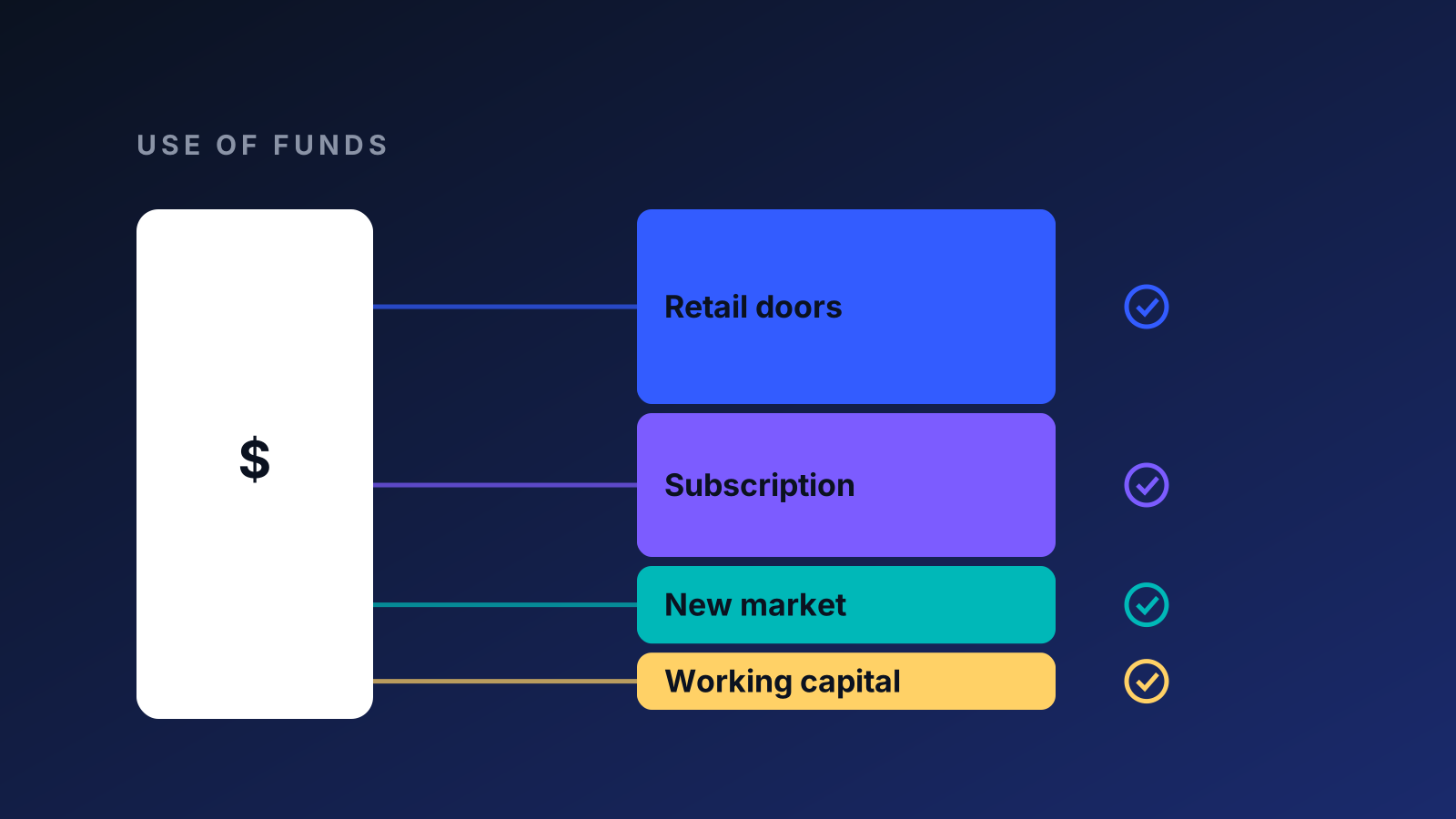
Split the money the way you split the upside: by growth engine. Then every dollar has a job and a deadline.
Department split vs. engine split
The same illustrative $3M raise, two ways.
| Department split | Growth-engine split | ||
|---|---|---|---|
| Marketing | $1.2M | Retail doors — inventory, trade spend, field support | $1.2M |
| Operations | $0.8M | Subscription — acquisition with a payback target | $0.9M |
| Team | $0.6M | New market — launch and first months of data | $0.5M |
| Product | $0.4M | Working capital — inventory for the plan above | $0.4M |
The left column could describe any company. The right column could only describe yours, and each line maps to a bar on your upside slide. When the use of funds and the upside case use the same engines, the deck stops being two stories and becomes one.
The five things on the slide
- The amount. One number, not a range.
- The minimum close. The smallest amount you can operate on. It tells investors you have done the math and lets you start deploying before the round is full.
- The instrument. Equity, a note or both, decided before the first meeting.
- The split by growth engine. Four or five engines, no more. Past that, nothing is a priority.
- The twelve-month milestones. One per engine, stated plainly enough to check later. "Two new national retail partners." "Subscription payback under nine months."
Valuation is not on the slide. Keep it for the room. (More on the full ask, and where it sits in the deck, in how I build the deck.)
The consumer-brand part nobody writes about
Inventory is not a growth engine. It is fuel for one. Investors know physical brands need stock. What makes them nervous is inventory as a big, vague line with no link to the plan. Show it as working capital, sized to the engines above it, and say how much of the seasonal build you will fund with inventory or PO financing instead of equity.
Retail costs more than the order. Slotting, trade spend, demos, fixtures, and the cash stuck in receivables while you wait to be paid. If retail is an engine, its line has to include all of that, or the milestone will not happen on the budget.
Paid acquisition needs a payback rule, not a budget. "$900K for subscription acquisition" invites the question "at what CAC?" Put the payback target on the slide and the question answers itself. The way I set that target with finance is the gap between acquisition cost and twelve-month contribution per customer, and how long the business can wait to close it, six months or twelve, given its cash, its inventory commitments and its EBITDA plan.
The strongest engine lines I have seen are a proven playbook pointed somewhere new. For a men's skincare brand with a working Amazon proposition, the next engine was Europe: the same positioning and playbook, thinner competition, and much of the tax and shipping groundwork already in place. An investor can check that in twelve months. "Grow Amazon" they cannot.
Mistakes I see on almost every first draft
- "General corporate purposes." It reads as "we haven't decided."
- Percentages without dollars. Investors do the multiplication anyway. Save them the step.
- Milestones that can't be checked. "Build brand awareness" is not a milestone.
- A split that doesn't match the forecast. If the model spends $600K on retail and the slide says $1.2M, the reconciliation pass should have caught it.
- A runway the model can't support. State the months the round buys, and make sure the cash-true number agrees.
A quick test before you send it
Cover everything on the slide except the milestones. Can someone guess roughly how the money is split from the milestones alone? If yes, the slide is honest. If the milestones would fit any split, they are not milestones.
The use of funds slide is a promise with a date on it. Make it specific enough that you would be happy to be held to it.
FAQ
What should a use of funds slide include?
The total raise, the minimum close you can operate on, the split of the money by growth engine, the milestone each engine should hit in twelve months, and the runway the round buys. Valuation stays off the slide.
Should use of funds be split by department or by initiative?
By initiative, meaning the growth engines in your upside case. A department split tells investors who gets paid. An engine split tells them what the money produces and lets them check it a year later.
Can a consumer brand use investment for inventory?
Yes, but show it as working capital sized to the growth plan, not as a vague line. Many brands fund part of the inventory build with inventory or PO financing so the equity goes into growth rather than stock.
How much runway should the raise buy?
Typically eighteen to twenty-four months at the planned burn: enough to hit the milestones that make the next round straightforward, with a buffer.