 DirectToGrowth Co.
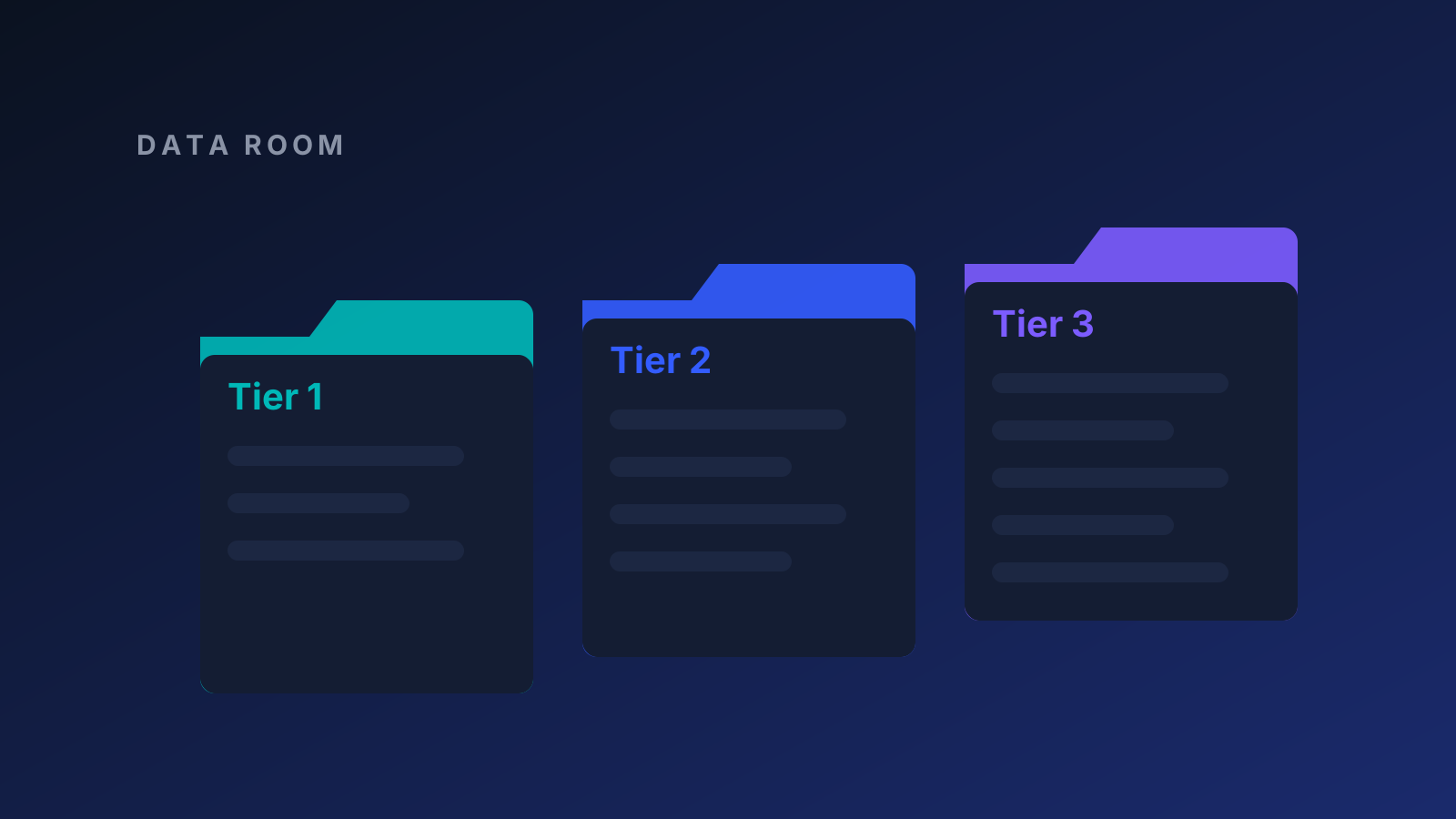
The data room checklists that rank on Google are written for software companies. Cap table, incorporation documents, product roadmap, customer contracts. All necessary. None of it is where an investor in a consumer brand spends their diligence time.
They want the things you can't fake: order data, cohorts, inventory, and what happens to your product once it is on a retail shelf.
A good data room is the diligence questionnaire, answered before anyone sends it.
Open it in tiers
Don't give everyone everything on day one. Interest earns access. It protects sensitive data, and it shows you which investors are doing real work and which are collecting decks.
The checklist
| Folder | What goes in it | Tier |
|---|---|---|
| 01 Deck | Short deck (first meeting). Full deck with appendix, built from the same source file. | 1 / 2 |
| 02 Metrics | One-page scorecard: revenue, growth, gross and contribution margin, repeat rate, CAC, payback. Definitions on the same page. | 1 |
| 03 Financials | Monthly P&L for 24+ months, balance sheet, cash flow. Accountant-prepared statements if you have them. | 1 / 2 |
| 04 Model | The operating model: assumptions, P&L by channel, unit economics, base vs. upside. | 2 |
| 05 Customers | Cohort retention and cumulative revenue per customer. Repeat rate by first product. Subscription churn. | 2 |
| 06 Acquisition | Spend, new customers and CAC by channel by month. Ad account exports. Your attribution method, written down. | 2 |
| 07 Retail | Doors by partner, sell-through and velocity per door, reorders, trade spend, chargebacks and deductions. | 2 |
| 08 Product + supply | COGS build per SKU, supplier list and terms, MOQs, lead times, open POs, 3PL inventory and aging. | 2 / 3 |
| 09 Brand proof | Reviews and ratings by channel, third-party test results, press, notable stockists. | 2 |
| 10 Legal + corporate | Cap table, incorporation documents, prior financings, IP and trademarks, key employment agreements. | 3 |
| 11 Contracts | Retail, distribution, supplier and 3PL agreements. Anything with exclusivity or minimums. | 3 |
| 12 Raw exports | Order-level export from your store platform and marketplaces, with personal data removed. | 3 |
The D2C-specific questions you should answer before they're asked
"What does a customer look like in month 12?" Cohorts, by month of first order, with cumulative revenue per customer. If you only show an LTV number, expect to be asked for the cohorts behind it, and expect to be asked whether that LTV is contribution after COGS, shipping and acquisition cost, or just revenue.
"How much of your growth is paid?" Spend and new customers by channel, side by side, and the method you use to judge them. I'd rather see one honest method written down than three dashboards that disagree. Put blended new-customer CAC and marketing spend as a share of net revenue next to the channel numbers, because that is what finance on their side checks first. (Here's how I think about attribution tools.)
"Does it sell once it's on the shelf?" Sell-through and velocity per door, not "now in 400 doors." Doors are distribution. Velocity is demand.
"What's sitting in the warehouse?" Inventory by SKU, aging, and open POs. Slow stock is a cash problem investors will find either way. Better that they find your explanation next to it.
Remove customer PII before anything goes in
Order exports are the most useful thing in a consumer data room and the most dangerous. Before uploading:
- Replace names, emails, phone numbers and street addresses with a customer ID.
- Keep only what the analysis needs: order date, customer ID, region, products, order value, discount, channel.
- Keep raw exports in Tier 3, with per-investor access and view tracking.
- Check your privacy policy and any platform terms before sharing customer-level data at all.
Three rules that make the room work
Every number reconciles. Revenue in the scorecard equals revenue in the P&L equals revenue on the deck. Run the same reconciliation pass you ran on the deck.
Every file has a date and a source. "P&L, through Sept 2026, from the accounting system." Investors shouldn't have to ask which version is current.
Build it before the first meeting. A half-built room in the middle of diligence costs weeks, and weeks cost runway.
The data room is where the deck's promises get checked. Build it so checking is easy. An investor who finds the explanation next to the number stops looking for the problem behind it.
FAQ
What should be in a startup data room?
The full deck and financial model, monthly financials, cohort and acquisition data, key contracts, the cap table and corporate documents, and the raw exports behind the headline numbers. A consumer brand adds inventory, supplier and retail sell-through data, because that is where its investors spend their time.
When should you open the data room to investors?
In tiers. The short deck and a one-page metrics summary before the first call, the full deck and model after a real second meeting, and contracts, legal documents and raw exports once there is a term sheet or close to it.
How do you share customer data in a data room safely?
Remove personal information first. Share order and cohort exports with customer IDs in place of names, emails or addresses, and keep the raw files behind per-investor access with view tracking.
What data room software should a startup use?
Any tool with per-investor access, view tracking and the ability to revoke access. The structure of the room and the reconciliation of the numbers matter far more than the tool.